You Make a $500 Payment. How Much Goes to Principal? Guess. Most People Have No Idea.
James Whitfield
You've seen that table of numbers. You ignored it. I don't blame you.
It looks like someone fell asleep on a keyboard. Rows and rows of digits. Payment number. Payment date. Payment amount. Interest. Principal. Balance. Over and over. For 360 rows if it's a 30-year mortgage.
But here's the thing. That table is the most honest document your lender will ever give you. It shows exactly where every dollar goes. It reveals the truth about your loan in a way the monthly statement never does.
And if you know how to read it, you can save thousands.
What an Amortization Schedule Actually Shows
Let's start simple. You borrow $20,000 for a car. 5 years. 7% APR. Monthly payment: $396.
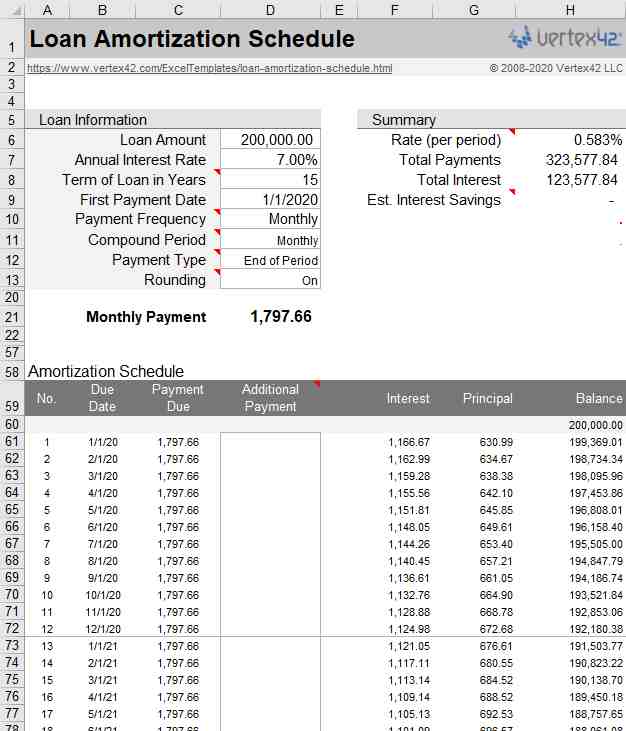
Your amortization schedule looks like this:
| Payment # | Payment | Interest | Principal | Balance |
|---|---|---|---|---|
| --- | --- | --- | --- | --- |
| 1 | $396 | $117 | $279 | $19,721 |
| 2 | $396 | $115 | $281 | $19,440 |
| 3 | $396 | $113 | $283 | $19,157 |
| 6 | $396 | $107 | $289 | $18,295 |
| 12 | $396 | $95 | $301 | $16,576 |
| 24 | $396 | $70 | $326 | $13,584 |
| 36 | $396 | $43 | $353 | $9,441 |
| 48 | $396 | $15 | $381 | $3,131 |
| 60 | $396 | $4 | $392 | $0 |
Look at Payment 1. $396 total. $117 to interest. Only $279 to principal.
That's 29.5% interest. On the very first payment.
Now look at Payment 60. $396 total. $4 to interest. $392 to principal.
That's 1% interest. On the last payment.
This is amortization. Front-loaded interest. The bank gets paid first. You get the leftovers.
The Mortgage Reality
Car loans are bad enough. Mortgages are worse. Because the numbers are bigger. And the timeline is longer.
$300,000 mortgage. 30 years. 7% APR. Monthly payment: $1,996.
| Year | Annual Payment | Interest | Principal | Balance |
|---|---|---|---|---|
| --- | --- | --- | --- | --- |
| 1 | $23,952 | $20,899 | $3,053 | $296,947 |
| 5 | $23,952 | $19,624 | $4,328 | $283,892 |
| 10 | $23,952 | $17,542 | $6,410 | $263,391 |
| 15 | $23,952 | $14,672 | $9,280 | $236,111 |
| 20 | $23,952 | $10,799 | $13,153 | $198,958 |
| 25 | $23,952 | $5,635 | $18,317 | $143,641 |
| 30 | $23,952 | $466 | $23,486 | $0 |
Year 1: You pay $23,952. $20,899 goes to interest. Only $3,053 reduces your debt.
You paid nearly $24,000 and your mortgage dropped by $3,000.
That's not a mortgage. That's an interest subscription with a side of principal.
Total interest over 30 years: $418,527.
You paid $718,527 for a $300,000 house.
I'm not kidding. That's the math.
Generate Your Own Schedule →Why the Front-Loading Matters
Most people don't understand why early payments are so interest-heavy. Here's the simple version:
Interest is calculated on your current balance. At the start of the loan, your balance is highest. So your interest charge is highest. As you pay down principal, the balance drops. So the interest drops.
It's not a conspiracy. It's math. But it's math that benefits the lender enormously in the early years.
If you sell your house after 5 years, you've paid $119,760 in total payments. But your balance has only dropped $16,108. You've built almost no equity. The bank got $103,652 in interest.
That's why banks love 30-year mortgages. They get most of their profit in the first 10 years. If you refinance or sell before then, they win twice.
How to Read Your Schedule Like a Pro
I want you to pull up your loan amortization schedule. Any loan. Mortgage. Car. Personal. Student.
Find these four numbers:
1. Payment 1: Interest vs. Principal ratio. If more than 50% goes to interest, you're in a high-interest loan. Consider refinancing or aggressive payoff.
2. The crossover point. When does principal finally exceed interest? On a 30-year mortgage at 7%, it's around month 150. Year 12.5. You've paid $249,000 before principal finally wins.
3. Total interest. Look at the bottom of the schedule. The total interest number. Stare at it. That's what this loan really costs.
4. Extra payment impact. Add $100 to one payment. See how the schedule shifts. The extra $100 goes 100% to principal. It doesn't just reduce your balance. It reduces every future interest calculation.
See Extra Payment Impact →The Extra Payment Secret
Here's what changed my life. I was looking at my mortgage amortization schedule in 2020. $1,450 payment. $980 to interest. $470 to principal.
I felt sick. I was paying nearly $1,000 a month just to keep the bank happy.
Then I added one extra payment. $1,450. Just one. In month 13.
The schedule recalculated. That single extra payment saved me $4,200 in interest over the life of the loan. And shortened my mortgage by 4 months.
One payment. $4,200 saved.
That's not a return. That's a miracle.
Because every dollar of principal you pay early eliminates interest on that dollar for every remaining month. $1,450 in month 13 eliminates $1,450 × 7% / 12 × 327 remaining months = $2,750 in interest. Plus the compounding effect. Total savings: $4,200.
That's why extra payments work. That's why the amortization schedule is your friend. It shows you exactly where to push.
What to Do With This Knowledge
1. Generate your amortization schedule. Use the calculator. See the real numbers.
2. Find the pain point. Where is most of your payment going? If it's interest, make a plan to attack principal.
3. Make one extra principal payment. Even $50. Watch the schedule shift. Feel the power.
4. Never look at your loan the same way again.
Generate Your Schedule Now →P.S. I showed my mortgage amortization schedule to my wife last year. She's a teacher. She doesn't care about finance. She cares about our kids. I pointed to Year 1: $11,760 in interest. "That's a semester of college," she said. I pointed to the total interest: $187,000 over 30 years. "That's four years of college," she said. "For both kids." She looked at me. "We need to pay this off faster." I didn't argue. I opened the Extra Payment Analyzer and we made a plan together. That's what the schedule does. It turns abstract numbers into real choices. Real trade-offs. Real motivation.
