You have six debts. Minimum payments total $800. You have $300 extra. What now?
I get this question all the time. People come to me with a list of credit cards, a car loan, maybe a personal loan from that “debt consolidation” place that charged them 18% interest. They’ve been making minimum payments for years. The balances barely move. They feel stuck.
I was there once. Not with debt – I’ve been lucky – but with confusion. Before I left banking, I used to review people’s financial statements and think “why doesn’t anyone teach this stuff?” The math isn’t hard. But nobody explains it. So people guess. And guessing usually means paying the minimum, because that’s what the bank asks for.
So let me walk you through exactly how to use the debt payoff calculator. Not in theory. With real numbers.
I remember someone I worked with – let’s call her Maria. She was a single mom, worked as a dental hygienist, made about $55k a year. She had five debts:
Credit Card A: $3,200 at 23% APR, min $85
Credit Card B: $7,500 at 21% APR, min $180
Store Card: $1,200 at 0% for six more months, then 27% after, min $40
Personal Loan: $4,500 at 15% APR, min $120
Car Loan: $11,000 at 9% APR, min $280
Minimum payments added up to $705. After rent, utilities, groceries, and her kid’s after-school care, she had about $250 left each month. Some months less. She wanted to know: “How do I make this $250 count?”
First thing we did – plug everything into the debt payoff calculator.
She typed in each debt: balance, interest rate, minimum payment. Then she entered her extra monthly amount – $250. The calculator showed her two timelines.
If she used the avalanche method (highest interest first), she’d pay off Credit Card A first ($3,200 at 23%), then Credit Card B, then the store card (but that 0% was a trap – more on that in a second), then the personal loan, then the car loan. Total time: 32 months. Total interest: about $3,900.
If she used snowball (smallest balance first), she’d pay off the store card first ($1,200), then Credit Card A, then the personal loan, then Credit Card B, then the car loan. Total time: 34 months. Total interest: about $4,700.
She looked at the numbers and said “avalanche saves me $800. That’s a lot.”
I said “it is. But look at the store card. That 0% is only for six more months. After that, it jumps to 27% – higher than both credit cards. So avalanche might actually mean paying the store card first, not the credit cards.”
She hadn’t thought about that. Neither had the calculator, unless she entered the future rate. So we adjusted. We set the store card at 27% starting in six months. That changed everything. Now avalanche said: store card first (27% soon), then Credit Card A (23%), then Credit Card B (21%), then personal loan (15%), then car loan (9%).
Same snowball? Snowball still said store card first because it was the smallest balance. So both methods actually agreed for once. That made her decision easy.
That’s the first lesson. The debt payoff calculator is a starting point, not a crystal ball. You have to think about future interest rate changes – like 0% promo periods ending. You also have to think about your own motivation.
Maria was disciplined. She didn’t need psychological wins as much as she needed the cheapest path. So she went with avalanche. She paid off the store card in three months – before the 0% ended – then attacked Credit Card A.
After six months, she had paid off two debts (store card and Credit Card A). Her monthly minimum payments dropped from $705 to $470. That freed up another $235 in her budget. She added that to her extra payment. Now she was putting $485 extra toward debt each month.
That’s the second lesson. As you pay off debts, your minimum payments go down. Roll that money into your extra payment. It accelerates everything.
We used the extra payment analyzer to see the impact.
She plugged in her original plan ($250 extra) versus her new plan ($485 extra starting in month seven). The difference was huge. Original payoff time: 32 months. New payoff time: 22 months. Interest saved: about $1,200.
She cried. Not sad tears. Relief tears. She said “I didn’t know I could be done in under two years.”
That’s what a good calculator does. It doesn’t just give you a number. It gives you hope.
Now, what if you don’t have an extra $250? What if you only have $50?
I worked with a guy named Carlos. He was a janitor, made $32k a year, had $15k in debt. His extra payment was $75 on a good month. He thought it was pointless. “At this rate, it’ll take forever,” he said.
We used the debt payoff calculator. With $75 extra, avalanche got him debt-free in 48 months. Four years. Not forever. He was shocked. He thought it would be a decade. Then we looked at what would happen if he increased his extra payment by just $25 a year – from a raise or cutting one coffee a week. That shaved off another eight months.
Carlos didn’t need a miracle. He needed a realistic timeline. The calculator gave him that.
So here’s how to actually use the tool, step by step, without any jargon.
Pull your statements. Every debt. Credit cards, student loans, car loan, personal loans, medical bills in collections. Write down: current balance, interest rate (APR), minimum monthly payment. If you don’t know the rate, call the company or check your online account. Don’t guess.
Enter everything into the calculator. Don’t skip any. Even a $400 medical bill matters. Especially a $400 medical bill, because it might be the smallest balance and give you a quick win.
Enter your extra monthly amount. Be honest. Not what you wish you had. What you actually have after rent, food, utilities, and a small buffer for unexpected stuff. If you’re not sure, start with $50. You can always adjust up later.
Run both strategies. Look at the timeline. Look at the total interest. Which one feels better to you? Not which one saves $50 more. Which one you’ll actually follow.
Look for trap debts. Any 0% promo ending soon? Any deferred interest? Any debts with a co-signer you want to protect? Factor those in manually.
Make a plan for the first three months. Not the whole 30 months. Just the next 90 days. Which debt are you attacking first? How much extra each month? Write it down. Put it on your fridge.
Revisit the calculator every three months. Your income might change. You might pay off a debt and free up minimum payment. Your extra amount might grow. Update the numbers. The calculator saves your data locally – you can come back.
That’s it. That’s the whole system.
I also want to show you something about amortization, because people get confused about how their car loan works.
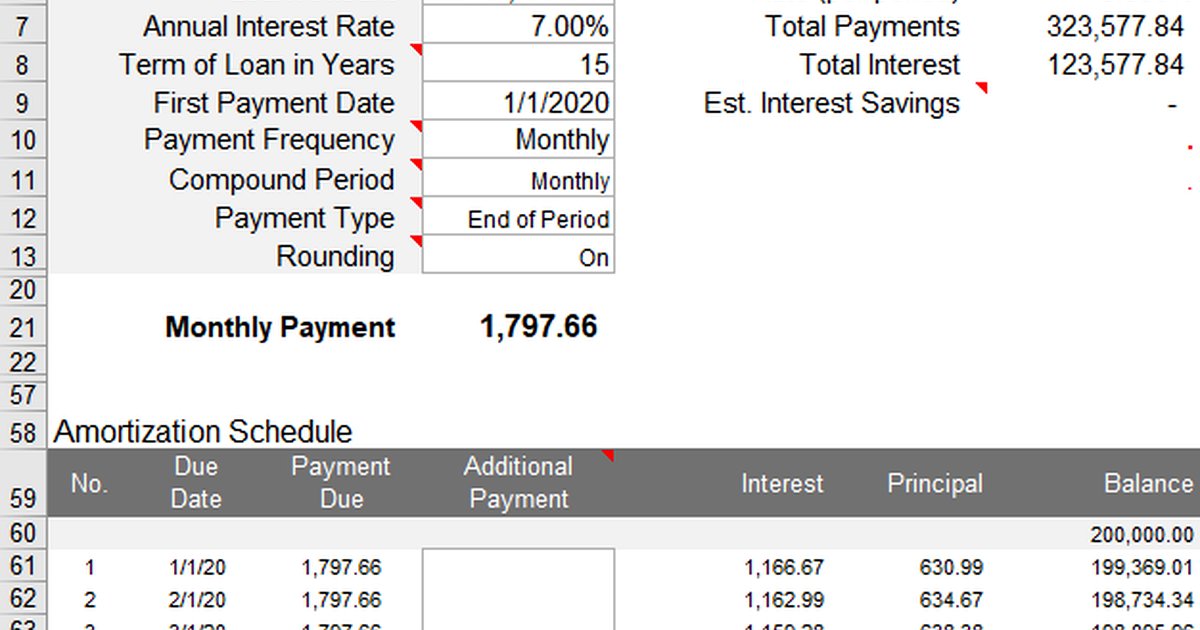
Let’s say you have a car loan for $20,000 at 8% for 60 months. Your payment is about $405. In the first month, $270 goes to interest, $135 to principal. That’s normal. But if you just pay the minimum, you’re barely touching the principal for the first year.
Now, what if you pay an extra $100 a month? That extra $100 goes entirely to principal. Over the life of the loan, you save about $1,200 in interest and pay it off 14 months early. That’s a 12% return on your $100 – better than any savings account.
That’s why extra payments matter. Not because they’re huge. Because they go straight to principal.
Maria didn’t have a car loan – hers was already at 9%, but she still paid extra toward it after the credit cards were gone. She said “I want to own my car free and clear.” She did it in 18 months instead of 54. That’s the power of rolling payments.
If you’re feeling overwhelmed, just start with one debt. Don’t try to optimize everything at once. Pay $20 extra this month toward the smallest balance. That’s it. Next month, maybe $30. Build the habit before you build the plan.
I’ll be real with you. The calculator won’t save you if you keep adding new debt. I’ve seen people use it perfectly, pay off three cards, then go finance a new couch at 25% interest. That’s like bailing water out of a boat with a hole in it. You have to stop spending on credit. Not reduce. Stop. At least until you’re out of the hole.
But if you’re ready – if you’re done with the minimum payment trap – the debt payoff calculator is your best friend. It shows you the finish line. It makes the invisible visible.
Go try it. Just enter your numbers. Don’t change anything yet. Just look. See where you stand. That’s the first step.
P.S. Maria finished her last payment on a Tuesday. She sent me a photo of her credit card balances – all zeros. Then she sent another photo of a cake she bought to celebrate. It said “Debt Free” in blue icing. I asked how it tasted. She said “better than any steak.”
James, Austin