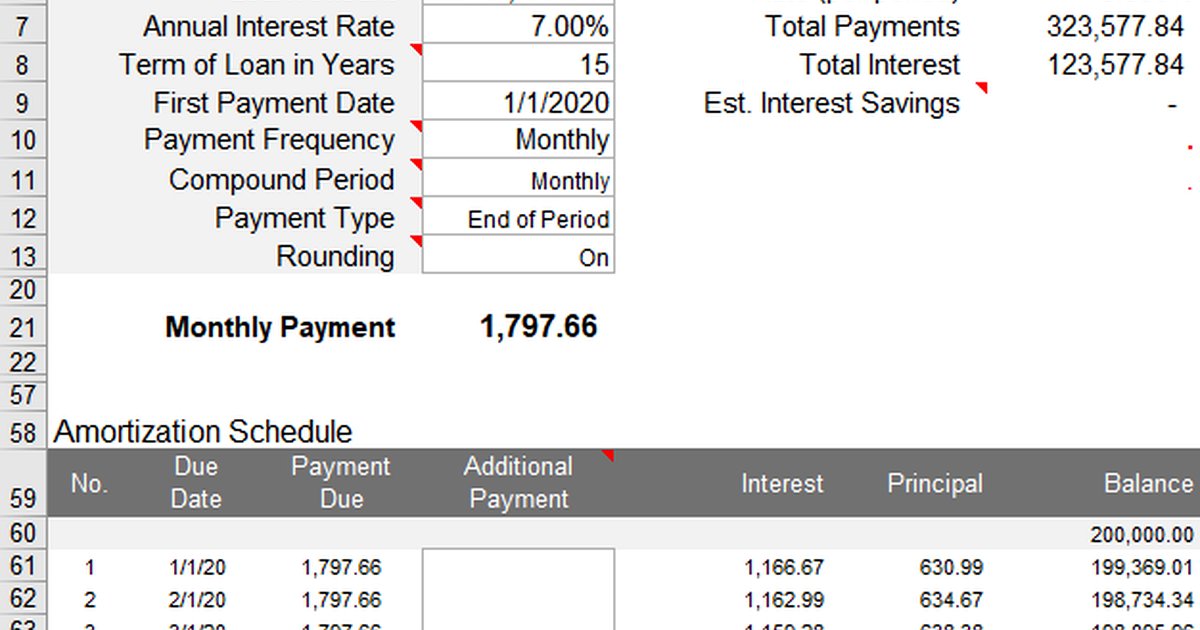
You’ve seen that table of numbers. You ignored it. I don’t blame you.
It looks like someone fell asleep on a keyboard. Rows and rows of digits. Payment numbers, interest, principal, balance. Your eyes glaze over. You flip to the next page of your mortgage closing documents and pretend it doesn’t exist.
But here’s the thing – and I promise I’m not saying “here’s the thing” – that table is the only honest part of your loan. The rest is marketing. The interest rate? Marketing. The monthly payment? Marketing. The amortization schedule? That’s the truth. It shows you exactly how much the bank is making off you, month by month, for years.
Someone I worked with – let’s call her Angela – had a mortgage for ten years. Ten years. She had no idea that in the first five years, she paid almost all interest. She thought she was building equity. She wasn’t. When she sold her house, she was shocked at how little principal she’d paid down.
I showed her an amortization schedule. She stared at it for a long time. Then she said “why didn’t anyone explain this to me?” Because the bank doesn’t benefit from you understanding.
So let me walk you through it. No jargon. No math that requires a calculator.
An amortization schedule is just a list of every payment you’ll make on a fixed-rate loan, from the first month to the last. Each row has four numbers: payment number, interest paid in that payment, principal paid, and remaining balance.
Look at the first row. That’s where the bank wins. On a 30-year mortgage, your first payment might be $1,500. Interest could be $1,200. Principal $300. You just paid the bank $1,200 to borrow money for one month.
Now scroll to the last row. On your final payment, maybe interest is $10 and principal is $1,490. You’re finally paying down the loan. That’s where you win.
The trick is to get from row one to the last row faster. That’s all extra payments do. They jump you ahead several rows.
I remember a guy named Steve. He had a $200,000 mortgage at 5% for 30 years. His first payment: $1,074 total, $833 interest, $241 principal. He paid an extra $100 a month. That extra $100 went straight to principal. It effectively skipped him ahead three rows every month. He paid off his mortgage in 22 years instead of 30, saved about $40,000 in interest.
He didn’t do anything complicated. He just looked at the schedule and said “I want to be in row 100 faster.”
The loan amortization schedule tool makes this easy.
Type in your loan amount, interest rate, and term. Click generate. You’ll see a table. Don’t try to read every row. That’s crazy. Just look at the first row and the last row. Then look at row 12 – one year in. Then row 60 – five years in. See how slowly the principal moves early on? That’s the cost of time.
Now, use the extra payment analyzer to see what happens if you add $50, $100, or $200 a month.
Let’s use a real example. A car loan – $30,000 at 8% for 60 months. Normal payment $608. Total interest $6,500.
Add $50 a month. Payment $658. Payoff time drops to 52 months. Total interest $5,200. Save $1,300.
Add $100 a month. Payment $708. Payoff time drops to 46 months. Total interest $3,900. Save $2,600.
That’s a 35% reduction in interest just by adding $100. Because every extra dollar goes to principal, not interest.
Someone I worked with – let’s call her Maria – had a $15,000 personal loan at 11% for 48 months. Her payment was $387. She added $63 a month to make it an even $450. That $63 saved her $1,100 in interest and got her debt-free nine months early. She said “that’s a free plane ticket to visit my sister.” She used the savings to fly home for Christmas.
So how do you read an amortization schedule without your brain melting? You don’t read it. You use it for two things.
First, find your “break point.” That’s the month where principal paid finally exceeds interest paid. On a typical 30-year mortgage, that’s around year 18 or 20. On a car loan, it’s around month 20 of 60. Knowing that number motivates you to make extra payments to reach it sooner.
Second, compare two different loans. If you’re shopping for a mortgage, run the amortization schedule for each offer. A 0.5% lower rate might not sound like much, but look at row one. On a $300,000 loan, 6.5% vs 6.0% – the difference in first-month interest is about $125. Over 30 years, that’s $45,000. That’s a car. That’s a year of college tuition.
I had a client named Kevin who was deciding between two car loans. One at 7% for 60 months, one at 6% for 72 months. The 72-month loan had a lower payment, but he looked at the amortization schedule. Total interest on the 60-month loan was $5,600. On the 72-month loan, $6,800. Plus he’d be in debt an extra year. He took the shorter term. “I’ll eat the higher payment,” he said. “I want to own my car before it falls apart.”
That’s what an amortization schedule does. It makes the long-term cost visible.
Now, a word about mortgages. Some people say “don’t pay extra on a low-interest mortgage, invest the money instead.” That’s fine if your mortgage is 3% or 4%. But today, rates are 6-7%. Paying extra on a 7% mortgage is a guaranteed 7% return. That’s better than the stock market’s average, and with zero risk. So it’s not a bad idea.
Use the debt payoff calculator to see how accelerating your mortgage fits with your other debts.
If you have credit card debt at 22%, pay that first. Mortgage comes later. But if your only debt is the mortgage, or if your car loan is at 9%, then extra payments are a smart move.
I’m not going to tell you that you must pay off your mortgage early. Some people prefer the liquidity of cash. That’s fine. But at least make an informed choice. Look at the amortization table. See what you’re paying in interest over the life of the loan. Then decide.
A friend of mine – not a client, just a guy – paid off his 30-year mortgage in 12 years. He said “I hated seeing that interest number every month.” He’s not richer than anyone else. But he sleeps better. That counts for something.
So here’s your homework. Pull up one loan you have. Any loan. Use the amortization tool. Look at the total interest over the full term. That number might shock you. Then look at the impact of an extra $50 a month. That number might inspire you. Then decide what to do.
P.S. Angela – the one who sold her house without building equity – she’s in a new house now. She pays an extra $200 a month toward principal. She told me “I’m not letting the bank win this time.”
James