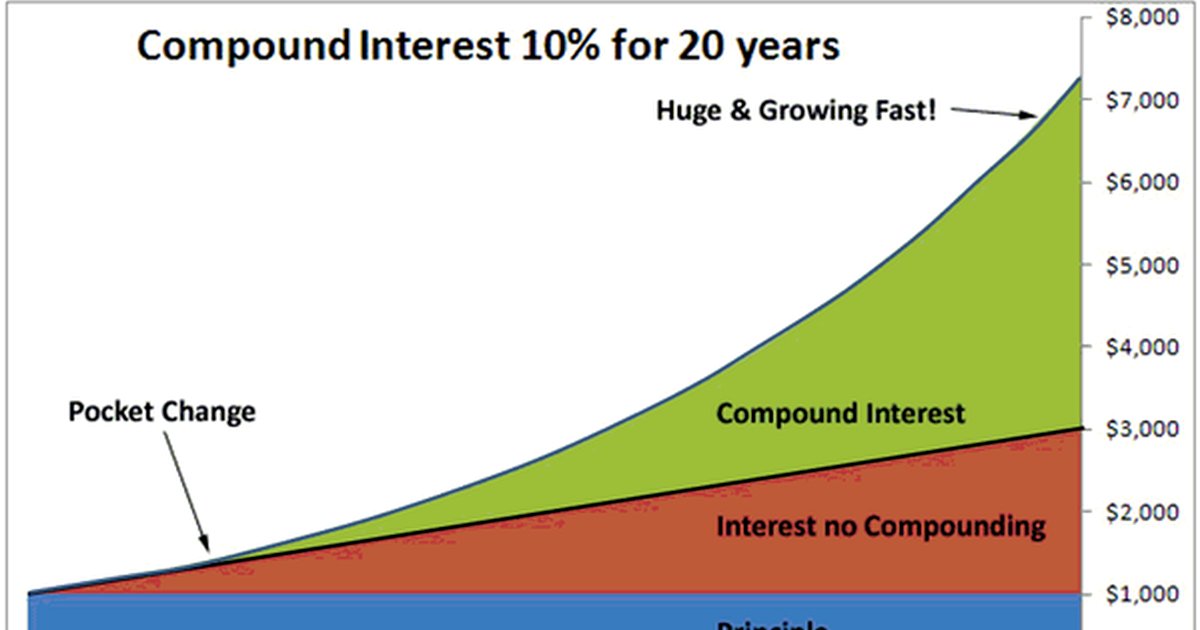
Compound interest is a miracle for investors. For borrowers? A nightmare.
I learned this the hard way. Not because I had credit card debt – I was lucky – but because I watched it destroy people at the bank. A guy would come in with $10k on a card, making minimum payments, thinking he was handling it. Five years later, he’d paid $12k and still owed $9k. He’d ask “where did my money go?” The answer: compound interest ate it.
Let me show you how it works, because most people don’t actually understand.
Simple interest is straightforward. You borrow $1,000 at 10% per year. You pay $100 in interest each year. After one year, you owe $1,100. After two years, $1,200. Linear. Predictable.
Compound interest is different. You pay interest on the principal plus the interest that already accrued. So that same $1,000 at 10% compounded monthly? After year one, you owe about $1,105. After year two, about $1,220. The gap grows over time. On a credit card with 22% APR compounded daily? It gets ugly fast.
Someone I worked with – call her Karen – had a $5,000 balance on a card at 23% APR. She paid the minimum each month, which started around $100. After one year of minimum payments, she had paid $1,200. Her balance had dropped to $4,800. She paid $1,200 to reduce her debt by $200. The rest went to interest. She said “I feel like I’m running in place.” She was. Compound interest was pushing her backward as fast as she moved forward.
That’s why the credit card interest calculator is so revealing.
Plug in a $10,000 balance at 22% with a minimum payment of 2% ($200). The calculator shows you’ll pay $23,000 in interest over 28 years. That’s not a typo. You’ll pay more than twice the original balance just in interest. And you’ll be in debt until your kids graduate college.
That’s the silent killer. Minimum payments are designed to keep you in debt. Banks love them. They’re not helping you. They’re helping their shareholders.
Now, here’s where compound interest works for you instead of against you. If you pay extra – even a small amount – that extra goes entirely to principal. And principal reduction stops the compounding machine. I had a client named Tony who owed $8,000 at 19%. He started paying $50 extra a month. That extra $50 saved him $3,200 in interest and cut his payoff time from 22 years to 3. Because the extra payment broke the compound cycle.
Another way to see this is through an amortization schedule. People think car loans and mortgages are different from credit cards. The math is the same, just with lower rates and fixed terms.
Take a $25,000 car loan at 8% for 60 months. Your first payment: $167 interest, $340 principal. By the last year, it flips – almost all principal. That’s amortization. The bank front-loads the interest so they get paid first. If you sell the car after two years, you’ll have paid mostly interest and barely touched principal. That’s why owing more than the car is worth is so common.
But here’s the counterintuitive part. On a fixed installment loan like a car or mortgage, compound interest isn’t as vicious as credit cards, because you’re required to pay a fixed amount that covers interest and principal. You can’t just pay the interest forever. So you eventually pay it off. Credit cards let you pay only interest indefinitely. That’s the trap.
So how do you fight compound interest when it’s working against you?
First, stop borrowing. Every new purchase on a credit card adds to the balance that’s already compounding. It’s like pouring gasoline on a fire.
Second, pay more than the minimum. Even $20 extra a month makes a difference. Use the extra payment analyzer to see for yourself.
I remember a teacher who had $15k in credit card debt. She added $75 a month extra – the cost of canceling her cable. That $75 saved her $6,000 in interest and got her debt-free three years faster. That’s a 600% return on her $75. You won’t get that in the stock market.
Third, consider a balance transfer to a 0% card. The transfer fee (3-5%) is usually less than what you’d pay in compound interest over a year. But you have to pay off the balance before the promo period ends, or the deferred interest hits and you’re worse off.
Fourth, if you have multiple debts, attack the highest interest rate first. That’s avalanche. It mathematically minimizes compound interest’s damage.
I know I said snowball is fine for motivation. But if you’re dealing with a 25% credit card and a 5% student loan, the compound interest on the credit card is so destructive that you should pay it first, even if it takes longer to see a win. A friend of mine had this exact situation. She ignored the student loan for a year, threw everything at the credit card. Paid it off in ten months. Then she went back to the student loan. Total interest saved: about $2,500. That’s a vacation.
One more thing – compound interest is why you should never, ever, under any circumstances, take a cash advance on a credit card. Cash advances often have a higher APR (like 25-30%) and start accruing interest immediately, no grace period. I’ve seen people take a $500 cash advance and end up paying $800 to clear it. Just don’t.
If you’re feeling overwhelmed, just pick one number. What’s the APR on your highest-rate debt? Write it down. Then decide: that’s the enemy. Attack it.
Compound interest is simple math. But simple math, over time, becomes brutal. The only way to win is to stop giving it new fuel and pay down the principal as fast as you can.
I’ll be honest – I don’t like credit cards. Not because they’re evil. Because most people don’t understand how the interest works. Banks count on that confusion. Don’t let them profit from yours.
P.S. Karen – the one with the $5k balance? She finally paid it off last year. It took her three years of extra payments. She sent me a screenshot of the zero balance. The subject line: “Compound interest can kiss my ass.” I think that sums it up.
James Whitfield