I paid the minimum on my credit card for three years. Every month. On time. Never missed. And my balance went from $8,200 to $9,400. I was paying them religiously, and I owed more than when I started. That is not debt repayment. That is a subscription service for financial misery.
The minimum payment on most credit cards is 1-3% of the balance or $25, whichever is higher. On my $8,200 balance, the minimum was $164. My interest rate was 24.99%. Monthly interest? $171. So I was paying $164 and accruing $171. Every month, I fell behind by $7. Three years of that? $252 in negative progress. Plus new charges. Plus fees. The math is designed to keep you in debt forever.
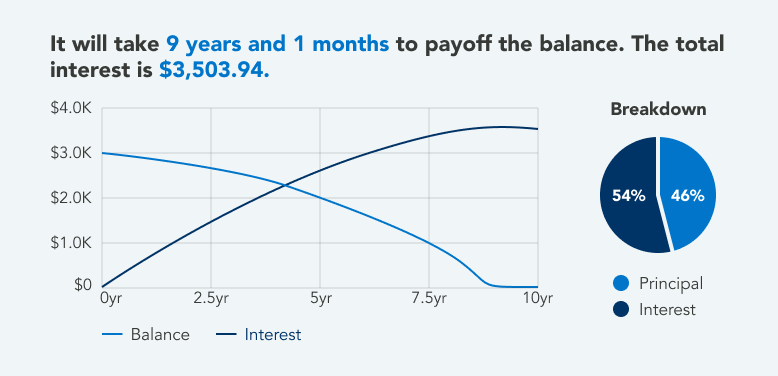
I ran the numbers. At minimum payments, it would take me 18 years to pay off that card. Eighteen. I would pay $12,800 in interest alone. On an $8,200 purchase. That is a $20,000 pair of shoes I bought in 2022. I do not even wear those shoes anymore.
The credit card companies know this. The minimum payment is not designed to help you. It is designed to maximize their interest income. They want you to pay the minimum. They want you to carry a balance. They want you to stay in debt for decades. Because that is how they make money. And they are very good at it.
I made a change. I stopped using the card. I cut it up. I set up automatic payments of $400 a month — more than double the minimum. At that rate, I will be debt-free in 28 months. Not 18 years. Twenty-eight months. And I will pay $2,100 in interest instead of $12,800. That is $10,700 in savings. Just from paying more than the minimum.
If you are paying the minimum on a credit card, please stop. Not the payments — keep paying. But stop thinking it is helping. It is not. It is keeping you in debt. Pay as much as you can. Even $50 extra a month changes the timeline dramatically. Because the minimum payment is a trap. And the only way out is to pay more.
I also want to talk about the psychology of minimum payments. They feel manageable. They feel responsible. You are "keeping up with your obligations." But that feeling is manufactured by credit card companies who understand behavioral economics better than you do. The minimum is low enough that you do not feel pain. High enough that they make money. It is the sweet spot of exploitation.
I had a client who paid the minimum on three cards for ten years. She thought she was being responsible. She owed $12,000 when she started. After ten years of minimum payments, she owed $11,400. She had paid $34,000 in interest and principal over a decade and reduced her debt by $600. Six hundred dollars. In ten years. She cried when I showed her the amortization table. I cried a little too.
The only way to beat the minimum payment trap is to pay more. A lot more. Ideally, pay the card off completely every month. But if you are carrying a balance, pay as much as you can. Double the minimum. Triple it. Throw every extra dollar at it. Because every dollar above the minimum goes straight to principal. And every dollar of principal you eliminate is a dollar that stops generating 24.99% interest. That is the math that matters.
I also want to address the people who say "I can not pay more than the minimum." I hear that. I have been there. But look at your spending. Look at your subscriptions. Look at your daily coffee, your DoorDash, your impulse Amazon purchases. I had a client who spent $180 a month on streaming services she did not use. She canceled three of them and put that $90 toward her credit card. She was debt-free in 14 months instead of never. The money is there. It is just hiding in small expenses that do not feel like expenses.
Credit card debt is not a character flaw. It is a mathematical trap. And the way out is mathematical too. Pay more. Spend less. Repeat. It is not complicated. It is just hard. And hard is not the same as impossible. I am living proof. I paid off $11,000 in credit card debt in 22 months. Not because I got a raise. Not because I won the lottery. Because I stopped paying the minimum and started paying attention.
— Marcus Tiernan, Denver, CO
Marcus is a financial counselor who fell into the minimum payment trap himself. He climbed out and now helps others do the same.