You make a $500 payment. How much goes to principal? Guess.
Most people have no idea. I didn’t either until I started working at a bank. I remember sitting in training, looking at an amortization table for the first time. It was a mortgage – $200,000 at 4% for 30 years. The first payment was $955. Only $288 went to principal. The other $667 was interest. I thought “that can’t be right.” The trainer said “that’s how banks make money.”
Amortization is just a fancy word for spreading out a loan over time. But the math works against you in the early years. On a long loan, like a mortgage or a car loan, you pay mostly interest at the beginning. The principal barely moves. That’s why it feels like you’re paying forever – because you are, unless you do something extra.
Someone I worked with – let’s call him Derek – had a car loan. $25,000 at 7% for 60 months. His payment was $495. He was two years in and couldn’t figure out why he still owed $18,000. He said “I’ve paid almost $12,000! How is the balance only down $7,000?”
I showed him an amortization table. The first year, of each $495 payment, about $145 went to principal, $350 to interest. He was renting the car from the bank. He wasn’t buying it.
Derek got mad. “So the bank gets paid first?” Yes. That’s the deal. You borrow money, you pay interest first. The principal is patient.
But here’s the good news. You can flip the script with extra payments.
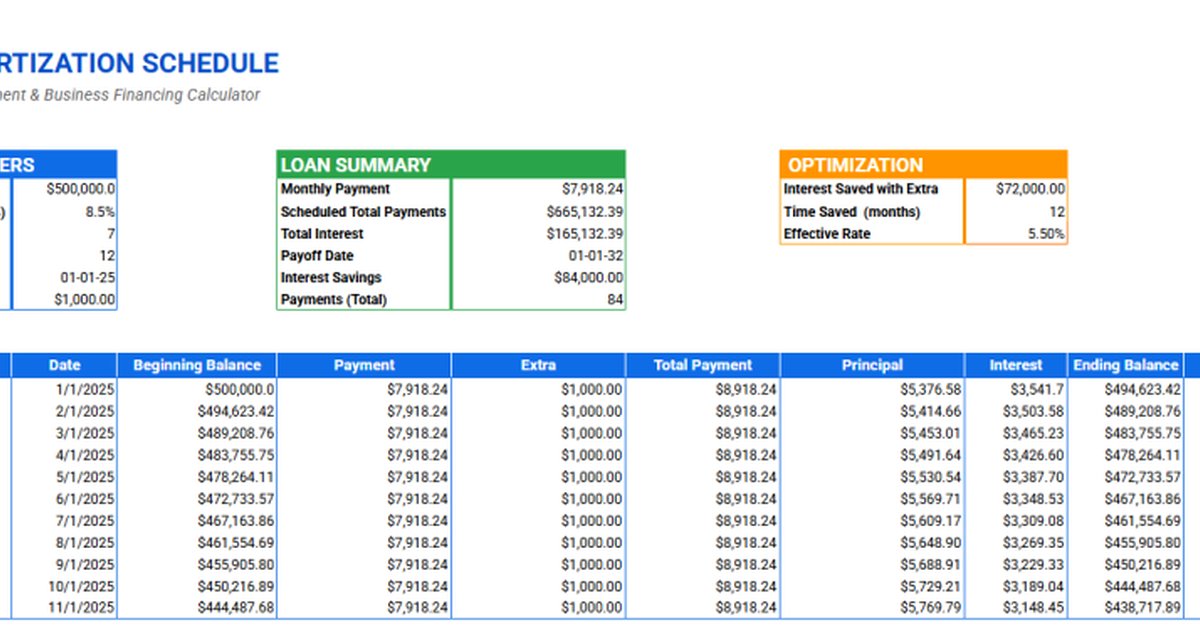
Let me show you how an amortization table works. Use the loan amortization schedule tool.
Plug in your loan details. The tool shows you month by month: payment number, interest paid, principal paid, remaining balance. Look at the first row. That’s where the bank wins. Now scroll to the last row. That’s where you win. The goal is to get to the last row faster.
How? Extra payments. An extra $50 a month goes entirely to principal. That’s not split. It’s all yours. So the effect is huge.
I remember a woman named Teresa. She had a $15,000 personal loan at 9% for 36 months. Minimum payment $477. She paid $550 instead – an extra $73 a month. That $73 saved her $1,200 in interest and got her debt-free six months early. She said “I didn’t think $73 would make that much difference.” But it did, because it went straight to principal.
The extra payment analyzer shows you exactly how much you save.
On a $20,000 car loan at 6% for 60 months, an extra $50 a month saves you $1,600 and pays it off one year early. An extra $100 saves you $2,800 and pays it off 18 months early. That’s a 15% return on your extra payment – better than any savings account.
So why doesn’t everyone do this? Because they don’t see the table. They just see the monthly payment and assume it’s fixed. But you can always pay more. There’s no penalty. (Well, some mortgages have prepayment penalties – check your contract. But credit cards and car loans usually don’t.)
Now, let’s talk about mortgages. That’s where amortization really hits home. A 30-year fixed mortgage is a beast. The first five years, you barely touch the principal. A $300,000 loan at 6% – first payment $1,800, only $300 to principal. After five years, you’ve paid $108,000 total, but your balance is still $275,000. Most of your money went to interest.
That’s not a conspiracy. That’s just math. But you can fight it.
An extra $100 a month on that mortgage saves you about $50,000 in interest and pays it off seven years early. An extra $500 saves you $150,000 and pays it off 15 years early. That’s life-changing money.
I had a client named Paul. He was a teacher. He had a $220,000 mortgage at 5%. He started paying an extra $200 a month – money he used to spend on eating out. He shaved eight years off his loan and saved $45,000 in interest. He said “I didn’t even miss the $200 after a few months.”
But here’s the catch. Before you throw extra money at a low-interest mortgage, pay off high-interest debt first. Credit cards at 22% are an emergency. Mortgage at 5% is not. Use the debt payoff calculator to prioritize.
Order your debts by interest rate. Attack the highest first. That’s avalanche. It saves the most money. Once high-interest debt is gone, then consider accelerating your mortgage.
One more thing about amortization tables. They’re also useful for understanding car loans. Car dealerships love to sell you on the monthly payment. “Just $450 a month for 72 months.” That $450 might be mostly interest if your rate is high. A 72-month loan at 8% on $35,000 – you pay almost $10,000 in interest. That’s a lot of money for a car that’s losing value.
If you can afford a higher payment, take a shorter term. 48 months instead of 60. Your payment goes up, but your total interest drops by thousands. Run the numbers before you sign.
I remember a guy named Marcus. He was looking at a truck. The dealer offered 84 months at 9%. His payment would be $650. Total interest $19,000. I told him to walk. He got a 48-month loan at 6% from a credit union. Payment $820 – higher – but total interest $7,000. He saved $12,000. He drove that truck for ten years. So the higher payment was worth it.
The amortization table makes all of this visible. Without it, you’re flying blind. With it, you see exactly where your money goes. And once you see it, you can’t unsee it.
So here’s what I want you to do. Pick one loan you have – car, mortgage, personal loan. Go to the amortization tool. Enter your numbers. Look at the first six months of payments. Count how much goes to interest. Then scroll to the last six months. See the difference. That’s the cost of time.
Then ask yourself: can I pay an extra $50 a month? If yes, run that scenario. See how much you save. That number will motivate you more than any pep talk.
People think debt is about discipline. It’s not. It’s about math. Once you see the math, discipline gets easier.
P.S. Derek – the guy with the car loan – he started paying an extra $80 a month. He paid off his loan 14 months early. He took the money he saved on interest and bought his wife a weekend trip. She still doesn’t know the trip came from interest savings. Now he might.
James Whitfield